
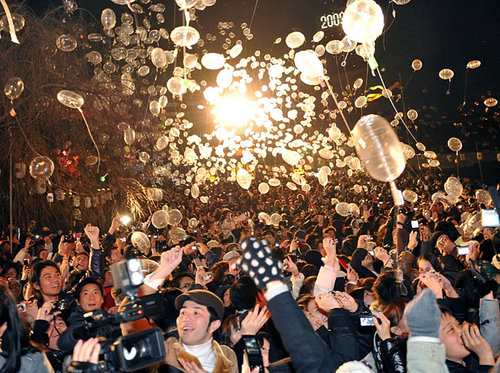
Source: http://japanholic-girl.blogspot.com/2013/01/new-year-in-japan.html
Just like most cultures, Japan has its share of holidays and special occasions. Some of these are familiar to us, such as Christmas (although it is not a national holiday in Japan). Others are not, such as Ocean Day (umi no hi), a holiday that celebrates the ocean (Public Holidays). Japan’s three most important holidays are New Year, Obon, and Golden Week.
New Year
New Year (shogatsu) is the most important holiday celebrated in Japan. In fact, it spans three whole days! From January 1-3, most stores close up to honor this important time. In Japan, each year is considered separate from previous years. Therefore, New Year is a time of fresh starts and new beginnings. Festivities usually start on New Year’s Eve, where bonenkai(year forgetting) parties a held to put away the troubles of yesteryear. Bamboo decorations called kadomatsu adorn homes (New Year).

Source: https://commons.wikimedia.org/wiki/File:Kadomatsu-decorative-jan4-2010.jpg
New Year’s Day starts with the observation of the year’s first sunrise, the hatsu-hinode. This day is believed to be a reflection of the rest of the year, so it is filled with fun and no work is done. Popular activities include kite flying, badminton, and spending time with family. Many people also visit shrines and send cards to loved ones during this holiday. Special dishes, such as osechi ryori are also enjoyed (New Year).
Obon
Obon is an important Buddhist event celebrated from the 13th-15th of July or August, depending on the region of Japan. According to tradition, the spirits of departed ancestors return during this time. Loved ones celebrate this reunion in a variety of ways. Many houses are covered in paper lanterns, which are meant to guide wayward spirits home. Special dances, called bon odori, are performed in honor of those who have passed. Visits to shrines and graves is also commonplace. A variety of other regional customs are also observed (Obon). Perhaps the most spectacular tradition is the Toro Nagashi, which means “flowing lanterns.” During this event, the Japanese release countless glowing paper lanterns into rivers or other bodies of water, seeking to guide the spirits back to rest (Afshar).

Source: https://www.pinterest.com/pin/276267758362098725/
Golden Week
Golden Week is not a single holiday or event, but actually four separate national holidays that occur within a seven day timespan. The first of these holidays is Showa Day (Showa no hi), the birthday of former Emperor Showa. It is celebrated on April 29th. Kenpo kinenbi (Constitution Day) comes next on May 3rd. It honors the ratification of Japan’s post-World War II constitution. The next day is Green Day, which honors the environment in memory of the nature-loving Emperor Showa. Finally, Children’s Day (or the Boy’s Festival) is celebrated on May 5th. This is a time in which families pray for the successful futures of their young boys. Carp banners (similar to the ones shown in the blog’s cover picture) are used for decoration. Girl’s have their own day on March 3rd (Golden Week).
Works Cited
Afshar, Dave. “The History of Toro Nagashi, Japan’s Glowing Lantern Festival.” Culture Trip, 11 Sept. 2017, theculturetrip.com/asia/japan/articles/the-history-of-toro-nagashi-japans-glowing-lantern-festival/.
“Golden Week.” Japan-Guide, 6 Jan. 2019, http://www.japan-guide.com/e/e2282.html.
“New Year.” Japan-Guide, 13 Oct. 2018, http://www.japan-guide.com/e/e2064.html.
“Obon.” Japan-Guide, 13 Jan. 2019, http://www.japan-guide.com/e/e2286.html.
“Public Holidays and Annual Events.” Japan-Guide, 13 Dec. 2018, http://www.japan-guide.com/e/e2062.html.
 Nippon Nuances
